By Austin Lawton, Staff Writer
A new era is now beginning for the IndyCar Series.
For the first time in 14 years, the premier open-wheel racing series in North America will have brand new car regulations. Announced on Tuesday morning, the IR-28 (see above image) will be the new car to usher in this new era of racing.
The new chassis and powertrain formula aims to deliver faster cars backed by Chevrolet and Honda, more action and improved drivability, in the Dallara built chassis. Testing for the new formula will begin this week and the series has tabbed the Indianapolis Motor Speedway Road Course and Oval, along with Sebring International Raceway as testing locations.
“We are pleased to unveil renderings of the new NTT IndyCar Series chassis that will take our sport into an exciting new era,” IndyCar President J. Douglas Boles said. “As you can imagine, a project of this magnitude takes an incredible amount of planning, collaboration and execution. I would like to thank all of our partners including Dallara, Chevrolet, Honda, Firestone and Shell, who have worked tirelessly to create a package that will enhance INDYCAR’s already incredible competition and industry-leading growth.
“With initial testing to begin this week, there is still plenty of work to do before 2028, but we are well on our way to showcasing a new era of IndyCar, which will include enhanced wheel-to-wheel competition, track records, standards in raceability and new benchmarks in safety. We are confident the IR-28 is the ideal package to move IndyCar forward for our teams, drivers, partners and fans.”
Per an IndyCar release, the series is aiming for track records with the new regulations. The IR-28 will be 100 pounds lighter than the current car, with power-to-weight ratios that will give the drivers a chance to push harder and deliver competitive racing.
The IR-28 features new rear-wing designs (see below pictures), featuring a superspeedway wing that provides maximum downforce, with a very limited drag.
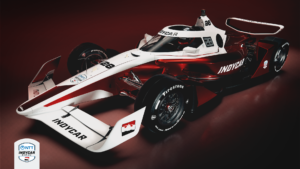
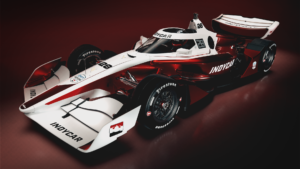
Aerodynamically, the car is purpose-built to enhance overtaking opportunities, optimizing wake from front-to-back. The speedway front wing is now more aerodynamically stable as well, in an aim to help the racing at the Indianapolis Motor Speedway. With the IR-28 being designed from the ground up, each bodywork element is aimed to allow the cars to follow each other closer in corners and throughout the racing field. Drivers will have electronically controlled adjustable anti-roll bars, giving advanced tuning, while cleaning up the cockpit, eliminating extra knobs and handles.
IndyCar also introduces the Custom AXIS Inertance Control Suspension System. The new system is highly tunable and aims to provide more mechanical grip through suspension optimization, reducing the aerodynamic load and giving teams setup flexibility. The new suspension system can now be considered spec, while also taking away development of the dampers, a part IndyCar teams have had development control over the last few years.
“I just think there is something exciting about this car. I love the aggressive way the car sits, the aeroscreen, which is now integrated into the car, and the rear wing, which looks sick,” Conor Daly said. “And this still looks like an INDYCAR SERIES car. I like that. And I like that the safety evolutions over the last few years have been incorporated. So, from the weight reduction, expected aero grip and more power from the engine manufacturers, this is the car that’s going to provide exactly what we’ve been asking for it to do.”
What Chevrolet and Honda bring to the table
In the rear of the car, both Chevrolet and Honda are providing 2.4-liter twin-turbocharged V6 internal combustion engines. The engines will produce up to 760 horsepower, while bringing increased torque, power and overall performance.
“Everyone at Chevrolet is looking forward to this next era of the NTT IndyCar Series and the debut of the IR-28 in 2028,” GM Vice President of Global Motorsports Competition Eric Warren said. “This new car builds on more than a decade of collaboration with INDYCAR, and we’re confident the new 2.4-liter, twin-turbo V6 engine will deliver the performance, sound and excitement INDYCAR fans expect from Team Chevy — the same standard that has produced 16 manufacturer championships and 13 Indianapolis 500 victories.”
“For more than 30 years, Honda has built upon its racing heritage as a key partner of the NTT Indycar Series, and we are excited to begin this next chapter with the IR-28 powered by our new American-made HRC V6 Hybrid powertrain,” Honda Racing Corporation USA President David Salters said. “IndyCar delivers some of the best racing on the planet, and this evolution of the formula creates new opportunities to enhance it—a lighter car, a more powerful hybrid powertrain, an even safer chassis and exciting chassis, and aerodynamic engineering challenges for our Honda associates and teams.
“Together, these advancements will help usher IndyCar into a new era. Honda is proud to be part of that future, supported by the long-term commitment we made to the series earlier this year. We can’t wait to see the IR-28 on track entertaining our IndyCar fans.”
Hybrid technology returns in the new era, featuring greater power storage, more deployment options and a package that is 20 pounds lighter than the current hybrid unit. IndyCar has reached a new partnership with Helix, a UK-based global leader in next generation solutions in building and delivering electric drive systems. The Helix-designed hybrid will be housed in the bellhousing of the car, between the combustion engine and the gearbox.
The new IndyCar hybrid platform will be the first battery-based Energy Storage System (ESS) in series history. BOLD Technology has partnered with the series to develop the ESS system, bringing approximately 14 times the energy storage capacity, than the current system on the cars today. This will give the teams and drivers flexibility in deploying the hybrid power.
Xtrac, as previously announced, returns as the supplier of the transmissions for the new car, adding a new gearbox that is 25 pounds lighter.
Safety Advancements
While the series aims to go for track records, especially at IMS, safety is the No.1 priority when doing so, especially when developing a new car. The IR-28 will keep the drivers safer than the previous car, drivers will have a wider cockpit and enhanced internal airflow into the cockpit.
The new chassis will be stronger when it comes to side impacts, absorbing more impact energy. The new car will also remain grounded during “nose-up” sliding or spinning incidents.
2026 Indy 500 winner Felix Rosenqvist notes the increased cockpit size as the first thing that stuck out to him about the IR-28.
“There is a ‘wow’ factor. The first thing that struck me is that it has more room in the cockpit and will fit differently-sized drivers, which is really good,” Rosenqvist said. “Secondly, it still has the IndyCar DNA, which was a worry for me that it wouldn’t look like an IndyCar Series car. This definitely does. It also has an aggressive look with an integrated aeroscreen and a car that addresses a lot of little tweaks that drivers have asked for. Dallara has delivered on almost everything. I’m super excited for the future.”